
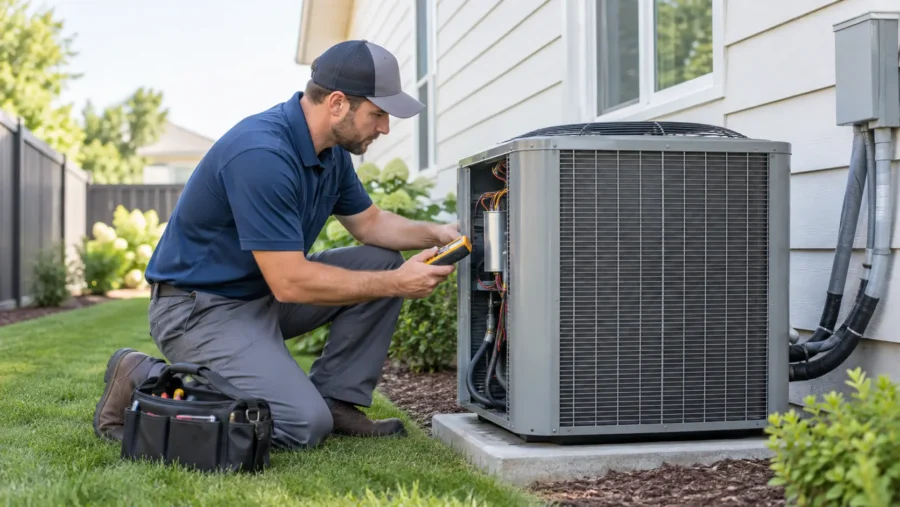
There’s no single right answer to the repair-or-replace question — only the right answer for your specific system. When a home air conditioning system starts acting up, that’s usually the first thing homeowners want to know: is it worth fixing, or is it time to consider something new?
This guide breaks down the practical factors worth weighing — age, repair history, efficiency, cost, and overall condition — so you can walk into that decision, and any conversation with an HVAC professional, feeling informed rather than rushed.
In This Guide
→ The Quick Answer
→ 5 Factors to Compare
→ Repair vs. Replace Table
→ Common Questions
→ Questions for a Pro
Quick Answer
Repair-vs-replace decisions usually come down to weighing five things together: the system’s age, how often it has needed repairs recently, its efficiency compared to newer equipment, the cost of the repair relative to the system’s value, and its overall condition. No single factor should make the decision on its own — it’s the combination that matters.
When Each Option Tends to Make Sense
Repair May Make Sense When…
- The system is relatively young and has a mostly reliable repair history.
- The current issue appears minor or isolated, not part of a recurring pattern.
- The unit has been maintained regularly and is otherwise in good condition.
- Your home’s cooling needs haven’t changed significantly (a new addition, major insulation changes).
Replacement May Make Sense When…
- The system needs frequent repairs, or the same issue keeps recurring.
- The unit is older and noticeably less efficient than current, ENERGY STAR–certified equipment.
- Repair costs start to represent a significant share of what a new system would cost.
- Comfort, airflow, or temperature consistency has been an ongoing concern rather than a one-time event.
“The most confident decisions come from comparing the full picture side by side — not from reacting to a single repair bill.”
5 Factors to Compare Before Deciding
Consider these together, not in isolation.
Age of the System
Most residential AC systems are designed to operate over a well-defined range of years, though this varies by brand, usage patterns, local climate, and maintenance history. Age alone doesn’t tell the whole story, but it’s a reasonable starting point.
Repair Frequency and Pattern
A single, isolated repair is very different from a system that keeps needing attention. Tracking how often service has been required over the past year or two can reveal a pattern worth raising with a professional.
Energy Efficiency & Smart Compatibility
Cooling technology has evolved, and newer systems are often designed to operate more efficiently, sometimes with better compatibility with smart thermostats and home energy management tools. An HVAC professional can compare your current system to newer options.
Repair Cost Relative to System Value
When a repair estimate is a small fraction of what a new system would cost, repair often feels reasonable. When it starts approaching a larger share of replacement cost, it’s worth weighing more carefully — costs vary widely by equipment, region, and installation complexity.
Overall System Condition
Beyond the immediate issue, the condition of the ductwork, the type of refrigerant used, and how consistently the system has been maintained all factor into a professional’s recommendation — and can be relevant documentation for a home warranty or homeowners insurance claim.
Repair vs. Replace at a Glance
| Criteria | Repair | Replace |
|---|---|---|
| Upfront cost | Typically lower than replacement, though it depends on the specific issue and parts involved. | Higher upfront investment; final cost depends on equipment type, home size, and installation needs. |
| Expected lifespan | Extends the life of the current system, but remaining lifespan depends on its age and condition. | Resets the expected lifespan with new equipment, typically backed by its own warranty terms. |
| Efficiency | Stays at the level of the existing equipment. | Newer, ENERGY STAR–certified systems are often built to different efficiency standards. |
| Reliability | May resolve the immediate issue, though other components could be aging at a similar pace. | All components start at the same age, which can reduce near-term service calls. |
| Long-term considerations | Can be practical if the system is otherwise healthy and repairs remain infrequent. | May reduce ongoing repair needs; may also affect home warranty coverage or insurance documentation. |
Costs and lifespans vary by region, equipment type, home size, and installation complexity — an HVAC professional can provide figures specific to your situation.
Common Questions About Repair vs. Replace
Is it normal for repair costs to vary a lot between homes?
Yes. Repair costs depend on the specific component, equipment brand, part availability, and local labor rates, so they’re not standardized nationally.
Does a newer AC always mean better efficiency?
Generally, cooling technology has advanced, but actual efficiency gains depend on the specific model and proper installation. An HVAC professional can compare options directly.
Can I get more than one estimate?
Yes — getting multiple professional evaluations is a common and reasonable step before deciding between repair and replacement.
Is there one “right” age to replace an AC system?
No single age applies to every system. Condition, repair history, and efficiency typically matter more than age on its own.
Questions to Ask an HVAC Professional
A short list to bring to your next service visit or consultation.
- What is the estimated remaining lifespan of my current system?
- Is this repair likely a one-time fix, or part of a recurring issue?
- How does my system’s efficiency compare to newer models?
- What would this repair cost, and how does that compare to replacement?
- Are replacement parts for my current system still readily available?
- Would a new system be compatible with a smart thermostat?
- Are there manufacturer warranties or local incentives relevant to my situation?
- What does the installation process involve, and how long does it take?
Don’t Decide Based on Age Alone
It’s tempting to let a system’s age be the deciding factor, but age is only one piece of the picture. A well-maintained unit can continue performing reliably well beyond a “typical” range, while a younger system with underlying issues may not be worth continued investment. The more reliable approach is to weigh age alongside repair history, efficiency, and a professional’s direct evaluation — not the number on its own.
Bringing It All Together
Deciding between repair and replacement isn’t about finding one answer that applies to every home — it’s about weighing your system’s age, repair history, efficiency, and overall condition together, then discussing those specifics with a qualified HVAC professional who can evaluate your equipment directly.
Final Checklist
- Consider the system’s age alongside its overall condition, not on its own
- Review how often repairs have been needed recently
- Compare the repair cost to the system’s overall value
- Ask how your system’s efficiency compares to newer models
- Get a professional evaluation before making a final decision
Keep Exploring
Official Resource · ENERGY STAR
When Is It Time to Replace Your AC? →
Watch · Ask This Old House
How to Maintain an Air Conditioner →
Official Resource · U.S. Department of Energy